
NEXT LEVEL RESOURCE MANAGEMENT
SKILLS MANAGEMENT
Know what your people can do. Find who you need, when you need them.

The skills problem every
growing business faces
You need someone with Python experience for a new project. Who in your 80-person company knows Python? And at what level?
You’re hunting through CVs from three years ago. Asking around departments. Relying on someone’s memory of “I think Sarah mentioned she’d done some coding…?” By the time you find the answer, the opportunity’s moved on.
Or worse: you hire externally for skills you already have sitting unused in your business. You’re paying for capability you can’t see.
DOK’s skills management solves this. Create comprehensive profiles for every team member, track competency levels across every skill, and instantly find the expertise you need, whether you’re staffing projects, identifying training needs, or proving capability to clients.
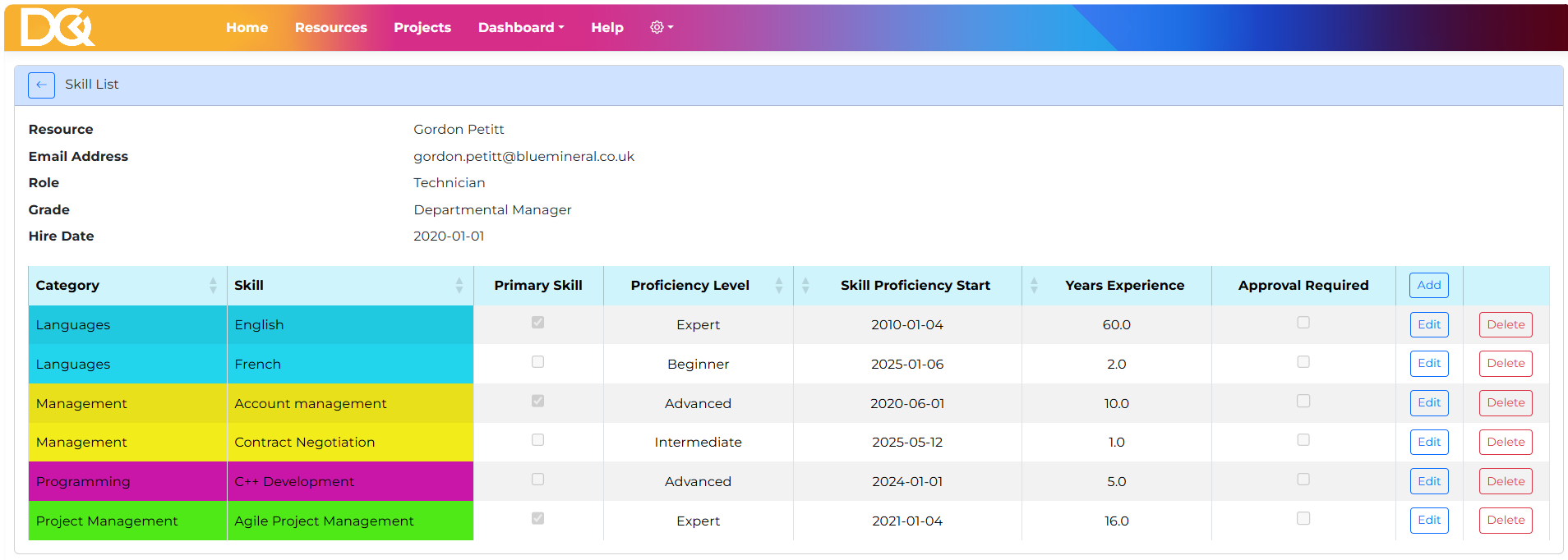
How DOK skills management works
Build complete skills profiles
Document every capability across your workforce in one central system. Not just job titles or departments, actual, measurable skills.
Create profiles that capture technical abilities, soft skills, certifications, languages, tools, methodologies, anything that matters to how your business delivers. Each person’s profile becomes a living record of what they can do, not just what their job description says they should do.
When you know what skills you actually have, you can deploy them strategically instead of accidentally.
Profile capabilities:
- Unlimited skills per person
- Custom skill taxonomies for your industry
- Multi-level competency scoring
- Experience
- Skills acquisition dates and history


Score competency levels that reflect reality
Not everyone with “project management” on their profile has the same capability. DOK lets you define competency levels that reflect real-world experience.
Structure your scoring however makes sense for your business: Beginner/Intermediate/Advanced. 1-5 rating scales. Junior/Mid/Senior. Awareness/Working/Expert. The system adapts to your needs, not the other way around.
When planning projects, you can specify exactly what level of expertise you need. Looking for someone with advanced Python skills, not just “knows Python”? DOK shows you who qualifies. Need intermediate-level CAD capability for a support role? Find them instantly.
This is how you stop over-speccing roles with senior people when mid-level talent would deliver perfectly.
Competency features:
- Customisable scoring frameworks
- Skill + competency level matching
- Competency progression tracking
- Self-assessment and manager validation
- Historical competency records
- Gap analysis against project needs
Find the right people for every project
Project planning shouldn’t start with “Who’s available?” It should start with “Who can actually do this?”
When setting up projects in DOK’s resource management software, define the skills and competency levels required for each role. The system instantly shows you who meets those requirements, who’s developing toward them, and where gaps exist.
Need someone with expert-level financial modelling and intermediate stakeholder management? DOK filters your entire workforce and surfaces qualified candidates, along with their current availability and utilisation.
This is resource allocation based on capability, not guesswork.
See multiple qualified people? The system shows you who’s underutilised, who’s ready for a stretch assignment, and who would benefit from the development opportunity.
Matching capabilities:
- Skills-based project requirements
- Competency-level filtering
- Multi-skill combination searches
- Availability + skills visibility


Identify training needs before they limit growth
Your pipeline shows three projects coming that need Agile coaching capability. How many Agile coaches do you actually have? Are they all fully utilised? Do you need to hire, or can you upskill existing project managers?
DOK’s skills intelligence shows you exactly where capability gaps exist, and more importantly, where they’re about to exist based on your forward workload.
Run gap analysis between the skills your projects require and the skills your people hold. Identify who’s one training course away from filling a critical gap. Spot where external hiring is genuinely necessary versus where internal development makes more sense.
When training becomes strategic instead of reactive, your capability grows deliberately with your business.
Gap analysis features:
- Current vs. required skills comparison
- Future demand forecasting
- Training ROI analysis
- Hire vs. train decision support
Prove capability when it matters
Clients ask: “Do you have qualified people to deliver this?” Tenders require: “Evidence of relevant expertise.” Audits demand: “Proof of competency.”
With DOK, you have comprehensive, auditable records of who can do what, at what level, supported by certifications, training records, and project history.
Generate capability reports instantly. Show a client you have five people with the specific certifications their contract requires. Prove to auditors that only qualified personnel were assigned to regulated work. Demonstrate to partners that you have the depth of expertise to scale.
This isn’t just resource management; it’s competitive advantage in the sales process.
Capability reporting:
- Skills inventory reports by department/role
- Competency distribution analysis
- Certification and qualification tracking
- Bid and tender capability evidence
- Client-facing skills summaries
- Compliance and audit documentation

Real-world skills
management scenarios
“Can we bid for this project? It needs three Senior Java developers and two DevOps engineers”
Instant answer with names, availability, and utilisation levels
“Sarah wants to move into data analysis, what training would close her skills gap?”
Compare current profile against analyst requirements, identify specific development needs
“We keep hiring externally for skills we might already have”
Skills visibility prevents duplicate capability investment and uncovers hidden expertise
“Client needs proof our team has required ISO certifications”
Generate capability report with certified personnel list and credential documentation
“Three team members want promotion, who’s actually ready?”
Compare current competency levels against senior role requirements with objective data
“Our pipeline shows capacity shortage in specific technical skills six months out”
Proactive upskilling or recruitment based on forecasted demand, not reactive panic

Strategic value beyond project allocation
For managers: Development conversations based on data
Performance reviews and development planning become objective conversations backed by skills profiles. “Here’s where you are, here’s where the next level requires you to be, here’s how we get you there.”
For HR: Succession planning that really works
Identify who has the competency mix for leadership roles. See where critical skills are concentrated in single individuals. Plan succession based on capability, not guesswork.
For Finance: Utilisation by skill level
Understand whether you’re deploying expensive senior expertise on work that mid-level people could handle. Optimise your skills mix for profitability.
For Business Development: Bid with confidence
Know your capability boundaries. Understand where you can credibly compete and where you’d be overreaching. Win work you can actually deliver.
For Operations: Future-proof your workforce
See emerging technology requirements in your pipeline. Identify which existing people can be upskilled versus where fresh capability is needed. Build the workforce your strategy requires.
Skills driven resource planning
Skills management isn’t separate from resource management, it’s fundamental to it.
When you’re allocating people to projects in DOK, skills data flows directly into the decision. The system doesn’t just show you who’s available. It shows you who’s available and qualified. Who’s available and ready for development. Who’s available but overqualified.
Your resource planning becomes capability-driven, not just capacity-driven. You’re not just filling slots, you’re deploying expertise strategically.
This is the difference between resource management and performance management.
See skills management in action
Want to see how DOK helps you find the right skills, deploy them strategically, and develop them deliberately?
Book a demonstration focused on skills management and capability intelligence.
BOOK A FREE DEMONSTRATION